Surveillance Technology Selector
Which technology suits your needs best?
Thermal vs Night Vision: What’s the Real Difference?
When you’re trying to see in total darkness, not all cameras are created equal. Two technologies dominate the low-light game: thermal imaging and night vision. They both help you spot movement when your eyes can’t, but they work in completely different ways. One sees heat. The other amplifies light. And depending on what you’re trying to do - whether it’s watching for intruders, tracking wildlife, or securing your property - one will outperform the other every time.
How Thermal Imaging Works (And When It Shines)
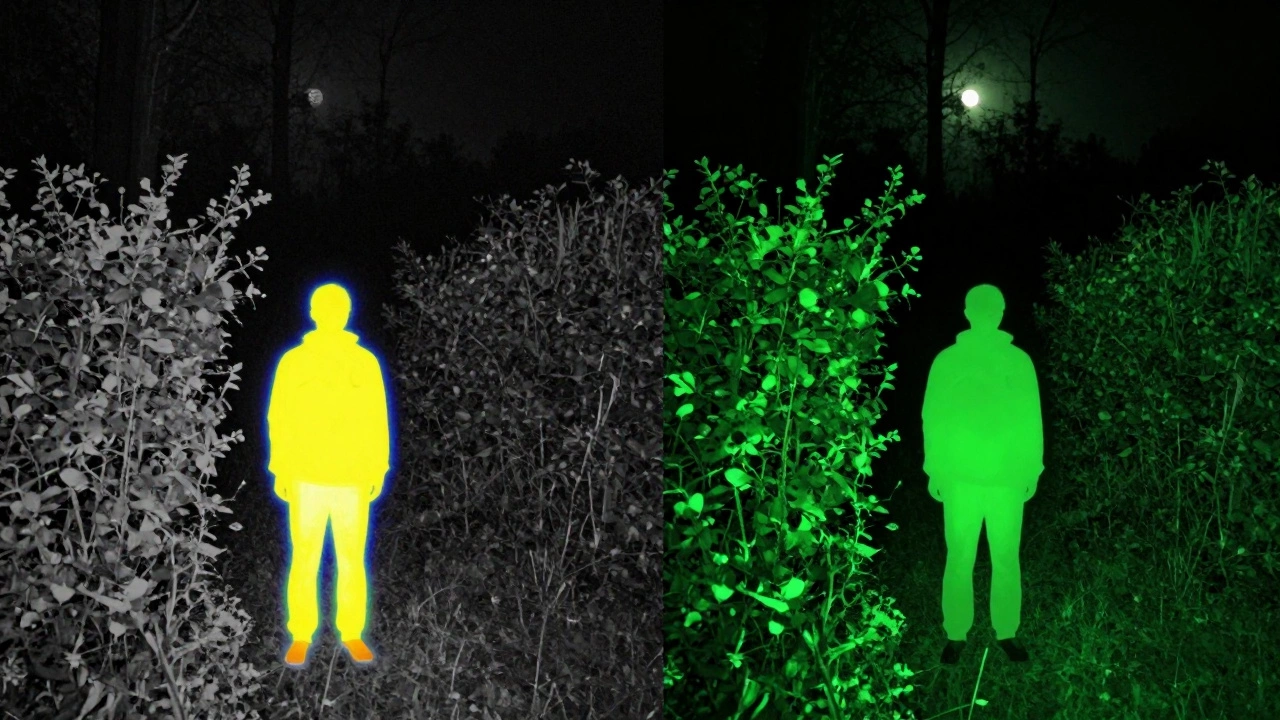
Thermal cameras don’t rely on any visible light at all. Instead, they detect infrared radiation - the heat that every living thing and machine gives off. A warm human body, a running engine, even a recently sat-on chair - they all show up clearly on a thermal screen. This is why thermal cameras can spot someone hiding behind bushes, through light fog, or even in heavy smoke. They don’t care if it’s pitch black outside. They see heat, and heat doesn’t disappear when the lights go out.
Modern thermal sensors, like the uncooled microbolometers found in consumer devices such as the AGM G2A Pro, can detect temperature differences as small as 0.03°C. That’s enough to pick out a deer bedded down in tall grass at 200 meters, something traditional night vision would miss completely. In field tests, thermal systems detected 98% of stationary deer in thick brush, while night vision only caught 42%. That’s not a small edge - it’s game-changing for hunters and security teams alike.
Thermal also works in conditions that blind other cameras. Heavy rain, fog, dust, and even some types of camouflage won’t stop it. The Night Vision and Electronic Sensors Directorate (NVESD) found thermal cameras maintained 92% target acquisition success in 0.5km visibility fog, while night vision dropped to 37%. If you need to monitor a property in all weather, thermal is the only choice that won’t let you down.
How Night Vision Works (And Where It Wins)
Night vision, on the other hand, needs at least a little bit of light. It takes the tiny amounts of visible and near-infrared light - from stars, moonlight, or even distant streetlights - and amplifies it thousands of times using image intensifier tubes. The result? A bright, green-hued image that looks like something out of a 1980s movie. But it’s real, and it’s sharp.
Where night vision excels is identification. At 150 meters, a Gen 3 night vision device like the PVS-31A can clearly show facial features, clothing details, and even the make of a vehicle. Thermal struggles here. At the same distance, thermal might show you there’s a person, but you won’t know if it’s your neighbor, a trespasser, or a raccoon. In a 2023 Optics Force study, night vision achieved 89% accurate facial recognition at 150m. Thermal? Just 34%.
That’s why military units often use both: thermal to detect movement at long range, then switch to night vision to confirm who or what they’re looking at. If you’re patrolling a fence line and spot a figure in the dark, thermal tells you there’s someone there. Night vision tells you if they’re carrying something, wearing a mask, or if it’s even a human at all.

Range, Cost, and Practical Limits
Thermal has the edge in detection range. With a good lens, thermal systems can spot a vehicle-sized target over 30 kilometers away. For humans, that’s typically 1,800 meters. Night vision maxes out around 550 meters under ideal conditions - and that’s only if there’s enough ambient light. In total darkness, night vision needs an infrared illuminator, which can give away your position. Thermal doesn’t need any external light source. It’s passive and undetectable.
But here’s the catch: thermal cameras cost more. A basic thermal monocular like the AGM G2A Pro runs around $300. A top-tier Gen 3 night vision device like the PVS-14 costs $1,800-$2,500. That’s a big difference. And if you want a dual-sensor system - like the FLIR Fusion or ATN ThOR 5 - you’re looking at $4,000 or more. For most homeowners, the cost of thermal is still a barrier.
There are also hidden drawbacks. Thermal can’t see through glass. If you point a thermal camera at a window, you’ll only see your own reflection. Night vision can work through windows just fine. Thermal also struggles in extreme cold - below -20°C, detection range can drop by 40%. Night vision, meanwhile, dies in total darkness without an IR illuminator. And if you accidentally expose a Gen 3 tube to bright light, you can permanently damage it. Thermal sensors don’t have that problem.
Real-World Use Cases: Who Should Use What?
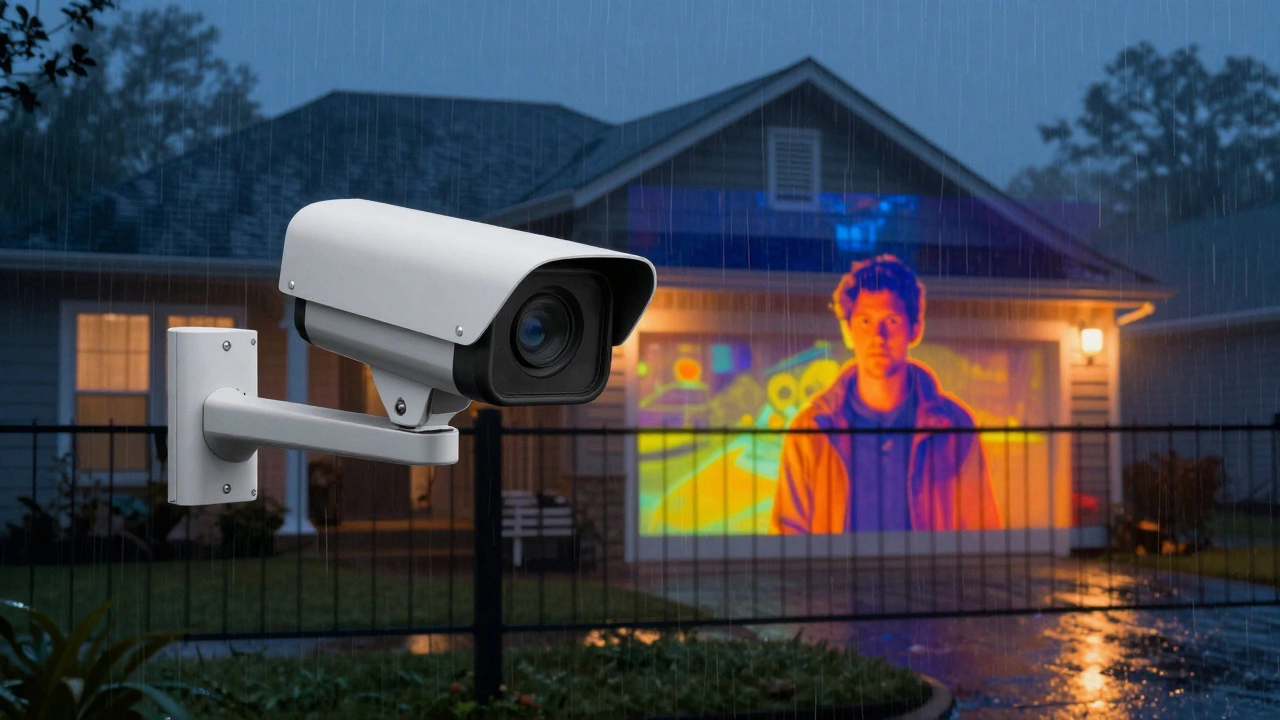
If you’re using this for home security, thermal is the better pick. It detects intruders regardless of lighting, weather, or camouflage. Reolink’s sales data shows 72% of new security camera installations in 2023 chose thermal for outdoor monitoring. Why? Because it catches people before they even get close to your house - even if they’re wearing dark clothes and walking slowly.
For hunters, thermal is unbeatable for spotting game in dense woods or at night. But many serious hunters carry both. They use thermal to find the animal, then switch to night vision to get a clear look at antlers or body size before taking a shot.
Law enforcement and search-and-rescue teams rely on thermal to find lost hikers, especially in forests or at night. Thermal can pick up body heat through tree cover, under debris, or even in water. Night vision is used for close-range identification - like reading a license plate or recognizing a suspect’s face during a takedown.
Aviation is a different story. Nearly all civilian night vision goggles used by pilots are night vision devices, not thermal. Why? Because they need to see runway lights, navigation beacons, and other aircraft - things that emit visible light. Thermal would just show heat signatures of the ground and clouds, which isn’t helpful for flying.
The Future: Is One Replacing the Other?
No. And that’s the key takeaway. Neither technology is replacing the other. They’re becoming more complementary. Companies like FLIR and L3Harris are now building hybrid devices that overlay thermal data onto night vision displays. These Fusion systems give you the detection power of thermal with the identification clarity of night vision - all in one unit.
Thermal prices are falling fast. Since 2020, they’ve dropped 12% per year. In 2015, a decent thermal scope cost over $2,000. Today, you can get one for under $500. Night vision prices have barely moved. The tech is mature, and the tubes are expensive to make.
But here’s the twist: digital night vision - like the ATN ThOR 5 - is blurring the lines. These are not traditional image intensifier tubes. They’re digital sensors that work in daylight, twilight, and total darkness. They don’t need IR illuminators, and they won’t burn out if you shine a flashlight on them. They’re not quite as sharp as Gen 3 night vision, but they’re getting close. And they’re more durable.
Final Decision: What Should You Buy?
Ask yourself these three questions:
- Do you need to detect something before you see it? → Go thermal.
- Do you need to know exactly what you’re looking at? → Go night vision.
- Are you on a budget and mostly in areas with some ambient light? → Night vision still makes sense.
If you can only pick one, and you’re using it for home security or outdoor surveillance, go thermal. It works in total darkness, through fog and brush, and doesn’t need any external light. It’s the only option that gives you true 24/7 coverage.
If you’re a hunter, shooter, or someone who needs to identify faces or license plates at distance, and you don’t mind carrying two devices or switching modes, night vision is still the gold standard for recognition.
And if money’s no object? Get both. Or get a Fusion system. Because in the real world, the best tool isn’t the one that does one thing perfectly - it’s the one that gives you the full picture.
Frequently Asked Questions
Can thermal cameras see through walls?
No, thermal cameras cannot see through walls. They detect heat on surfaces, not through solid objects. A thermal camera might show you that a wall is warmer on one side - perhaps from a heater behind it - but it won’t reveal what’s on the other side. This is a common myth. Thermal sees surface temperature differences, not X-ray vision.
Is night vision legal to use at home?
Yes, night vision devices are legal for home use in most countries, including the UK and US. However, export controls (like ITAR in the US) restrict high-end military-grade models from being sold overseas. For consumer-grade devices - like those sold by Sightmark or Pulsar - there are no legal restrictions on owning or using them on your property.
Do thermal cameras work in daylight?
Yes, thermal cameras work just as well in daylight as they do at night. In fact, they’re often more effective during the day because temperature differences between objects (like a warm car vs. cool pavement) are more pronounced. Thermal isn’t affected by sunlight, shadows, or glare - making it a true 24-hour solution.
Why do night vision images look green?
Night vision images appear green because the phosphor screen inside the image intensifier tube emits green light. Human eyes are most sensitive to green wavelengths, so this color provides the clearest image with the least eye strain over long periods. It’s not a limitation - it’s a design choice based on how our vision works.
Can I use thermal imaging to find a missing pet?
Absolutely. Thermal imaging is one of the best tools for finding lost pets, especially at night. A dog or cat’s body heat stands out clearly against cooler grass, pavement, or bushes. Many animal rescue teams use handheld thermal devices during night searches. Just remember: thermal shows heat, not shape. So you’ll need to interpret the blob - a warm, oval shape in the grass is likely your pet.
Which lasts longer: thermal sensors or night vision tubes?
Thermal sensors have no moving parts and no tubes to wear out. They can last 10+ years with normal use. Night vision image intensifier tubes, especially Gen 3, have a finite lifespan - typically 10,000 to 15,000 hours. That’s about 5-7 years of regular use. If you leave your night vision on overnight every night, you’ll need to replace the tube sooner.