Pet-Friendly Alarm Compatibility Checker
Enter your pet's details below to find the right motion sensor type for your home security system.
Up to ~11 kg
Up to ~27 kg
Up to 35 kg
Up to ~40 kg
You’re trying to leave the house, arm your security system, and walk out the door. But then you remember: Barnaby, your 30kg Labrador, is still inside. If you trigger the motion sensor, will the siren scream at 100 decibels while your dog panics? Or worse, will the monitoring company call you every time your cat jumps on the kitchen counter?
The short answer is yes, alarm systems work with pets, but not all of them do it well by default. Standard intruder alarms are often blind to the difference between a burglar and a golden retriever. To make them compatible, you need specific technology-primarily pet-immune sensors-and smart configuration. This guide breaks down how these systems function, what weight limits matter, and how to set up your home so your security doesn’t become a nuisance.
How Pet-Immune Technology Actually Works
Most modern home alarms rely on Passive Infrared (PIR) sensors. These devices don’t "see" movement like a camera; they detect changes in heat signatures. When an object warmer than its surroundings moves across the sensor’s field of view, the alarm triggers. The problem for pet owners is that dogs and cats are also warm-blooded and moving.
Pet-immune PIR sensors solve this through optical design and signal processing. They are engineered to ignore infrared energy near floor level, where most pets operate, or to filter out small thermal profiles. For instance, Johnson Controls’ DSC Bravo3P sensor uses "Multi-Level Signal Processing" and a specialized lens to reject animals weighing up to 60 lb (approx. 27 kg). It essentially draws an invisible line in the air. Anything below that line, or too small in mass, is ignored. Anything above it-like a human walking upright-is flagged as a threat.
Some advanced models, like the PowerG series from SuretyHome, use Target Specific Imaging (TSI). This tech analyzes the vertical position and apparent size of the heat source. It distinguishes a low-moving, small thermal profile (a cat) from a taller, larger target (a person). This isn't just about weight; it's about geometry and behavior.
Weight Thresholds: Why Your Dog’s Size Matters
Not all pet-friendly alarms are created equal. Manufacturers publish specific weight limits, and ignoring them leads to false alarms. If you have a Great Dane, a sensor rated for 25 lb won’t help you. You need hardware rated for higher masses.
Here is a breakdown of common weight thresholds found in the UK and global markets as of 2026:
| Sensor Type / Brand Example | Max Pet Weight (Imperial) | Max Pet Weight (Metric) | Best For |
|---|---|---|---|
| Basic Consumer DIY Kits (e.g., Smart Locks Guide specs) | Up to 25 lb | ~11.3 kg | Cats, small terriers, apartment living |
| DSC Bravo3P / Standard Professional Grade | Up to 60 lb | ~27.3 kg | Medium dogs, multiple small pets |
| ADT UK Pet-Friendly PIRs | Up to ~77 lb (35 kg) | 35 kg | Large breeds like Labradors or Shepherds |
| Leedarson / High-Sensitivity Models | Up to 80 lb | ~36 kg | Very large dogs, active households |
| PowerG PG9914 / PG9984P Series | Up to 85-88 lb | ~38.6-39.9 kg | Giant breeds, combined pet loads |
If you have two medium-sized dogs totaling 50 kg, a sensor rated for 35 kg individually might fail if both move simultaneously in the detection zone. Always check if the rating applies to individual animals or combined weight. Most professional installers will advise you to match the sensor rating to your heaviest pet, plus a safety margin.
Placement Strategy: The Hidden Key to Success
Even the best pet-immune sensor fails if mounted incorrectly. The physics of PIR detection means that height and angle are critical. If you mount a pet-immune sensor too low, it enters the "pet zone" and starts detecting your dog’s back or head. If you mount it too high, you might miss a burglar crouching or crawling.
Follow these placement rules to minimize false alarms:
- Avoid Staircases: Stairs are notorious false-alarm traps. A dog running up stairs crosses multiple detection zones rapidly. Mount sensors parallel to staircases, not facing them directly, or skip motion coverage on stairs entirely.
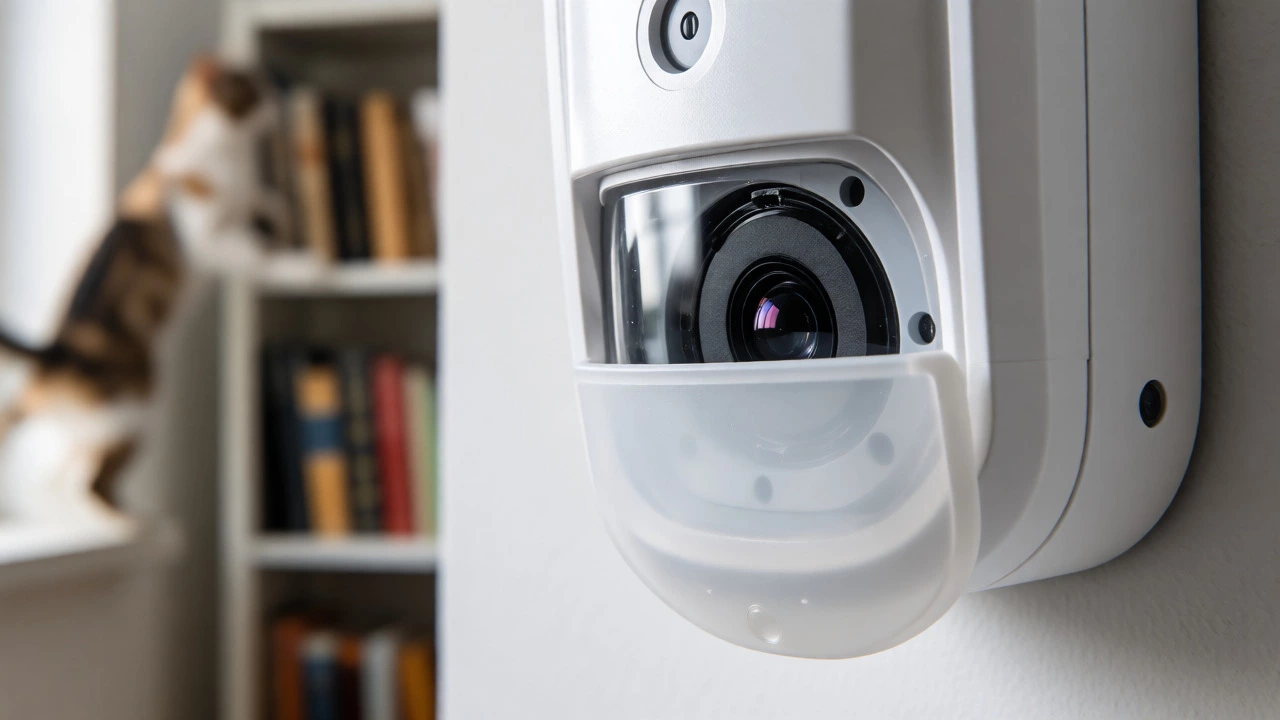
- Watch the Furniture: Cats love windowsills and tall bookshelves. If your sensor covers a window ledge, your cat jumping up there can trigger the alarm. Use furniture to block sightlines or adjust the sensor angle downward slightly.
- Mount Height Matters: Follow manufacturer guidelines strictly. Typically, this is 2.1-2.4 meters (7-8 feet). Do not improvise unless you have tested the zone.
- Use Masks: Some sensors, like the PowerG PG9914, come with snap-on plastic masks. These physically block the lower part of the lens. If your dog is under the threshold but still triggering alarms, add a mask to raise the effective detection floor.
Alternatives to Motion Sensors: Entry Points and Glass Break
If you have a very large dog, a pack of energetic cats, or simply want zero risk of false alarms, consider relying less on interior motion detectors. Experts from SecurityCompassHQ and Reddit communities consistently recommend anchoring your system with entry-point sensors.
Magnetic contact sensors on doors and windows are inherently pet-proof. They only trigger when the magnetic circuit is broken-meaning someone opened the door or window. Your dog cannot open a locked door. Similarly, glass break detectors listen for the specific frequency of shattering glass, not general noise. While a loud bark won’t trip them, a thrown brick will.
This strategy works best in smaller homes or apartments where securing perimeter points is feasible. For larger properties, you might combine entry sensors with a few strategically placed pet-immune motion sensors in hallways or living areas, avoiding rooms where pets spend most of their time.
The Role of AI Cameras and Video Verification
Technology has moved beyond simple heat maps. Modern security cameras use Artificial Intelligence to distinguish between humans, vehicles, and animals. Brands like Arlo, Eufy, and Ring offer smart detection features that can be configured to send alerts only for human-shaped objects.
Video verification is a powerful tool for monitored systems. When an alarm triggers, the monitoring center can review a short video clip before dispatching police. If the footage shows your dog chasing a ball, the operator cancels the dispatch. This saves you from false alarm fines, which are increasingly common in UK councils for repeated unverified activations.
Pro Tip: Inform your monitoring provider about your pets. Some services allow you to register "pet zones" or note that pets are present, which influences how operators interpret ambiguous signals.
Real-World Scenarios: What Works and What Doesn’t
Let’s look at three common household scenarios based on user experiences from 2021-2026:
- The Apartment Cat Owner: You live in a Bristol flat with one indoor cat. A basic DIY kit with 25 lb-rated sensors works perfectly. You place motion sensors in the hallway and living room, avoiding the cat tree. False alarms are rare.
- The Family with Two Labs: You have two 30 kg Labradors. A standard 25 lb sensor will fail constantly. You need ADT or Vivint-grade equipment rated for 35+ kg. You avoid motion sensors in the kitchen (where dogs wait for food) and rely on door contacts and glass break detectors. Interior motion is limited to upstairs bedrooms where dogs rarely go.
- The Multi-Pet Chaos: Three cats and a Jack Russell. The Jack Russell jumps high and fast. Even pet-immune sensors struggle with erratic vertical movement. The solution here is hybrid: use entry sensors everywhere, and only use motion sensors in long corridors where pets run straight, not zigzag. Add indoor cameras with AI filtering to monitor activity without triggering sirens.
Troubleshooting Persistent False Alarms
If your system is still going off despite using pet-immune gear, check these common pitfalls:
- Sunlight and Heat Sources: Direct sunlight hitting a PIR sensor can cause temperature fluctuations that mimic movement. Ensure sensors aren’t pointing at south-facing windows or radiators.
- Battery Low: Weak batteries can cause erratic sensor behavior. Replace them annually, even if they seem fine.
- Pet Behavior Changes: Did your dog start sleeping on the sofa? If the sofa is in the detection zone, you may need to re-angle the sensor or use a pet mask.
- Interference: Wireless sensors can suffer from RF interference. Keep them away from microwaves or dense Wi-Fi routers.
Remember, no system is 100% perfect. The goal is reduction, not elimination. A few false alarms a year are manageable; daily ones mean your setup needs adjustment.
Can I use any motion sensor with my pet?
No. Standard motion sensors detect any change in heat within their range. You must use sensors explicitly labeled as "pet-immune" or "pet-friendly." These have specific lens designs and software algorithms to ignore animals below a certain weight or height threshold.
What happens if my dog weighs more than the sensor limit?
If your pet exceeds the manufacturer's stated weight limit (e.g., a 40kg dog on a 35kg-rated sensor), the sensor will likely trigger the alarm when the dog moves through the detection zone. You should upgrade to a higher-capacity sensor, such as those rated for 80lb+, or relocate the sensor to an area your dog does not enter.
Are door and window sensors safe for pets?
Yes, absolutely. Magnetic contact sensors on doors and windows are completely unaffected by pets. They only trigger when the door or window is physically opened. They are the most reliable component for pet owners because they eliminate the possibility of false alarms from animal movement.
Will my cat trigger a glass break detector?
Generally, no. Glass break detectors are tuned to the specific acoustic frequency of breaking glass. However, if a heavy object falls on the floor nearby, it might occasionally cause a false trigger. Placing the detector correctly and ensuring it has a sensitivity adjustment can mitigate this.
Do I need professional installation for pet-friendly alarms?
Not necessarily. Many DIY systems like SimpliSafe or Ring offer pet-immune sensors that are easy to install. However, for complex layouts, multiple large pets, or hardwired systems, professional installation ensures optimal sensor placement and correct configuration of pet immunity settings, reducing the risk of false alarms.