Rain-Resistant Motion Sensor Selector
Compare how different motion sensors handle rain with real-world data from industry tests.
Rain Intensity
Sensor Type
Your Results
Your Sensor
Rain Condition
Estimated Triggers
1-8
Triggers per hour during rain
Recommended Action
This reduces triggers by 60-80% without upgrading your system
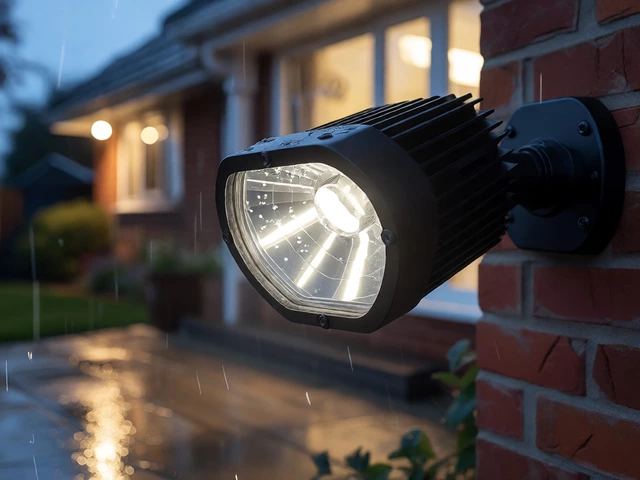
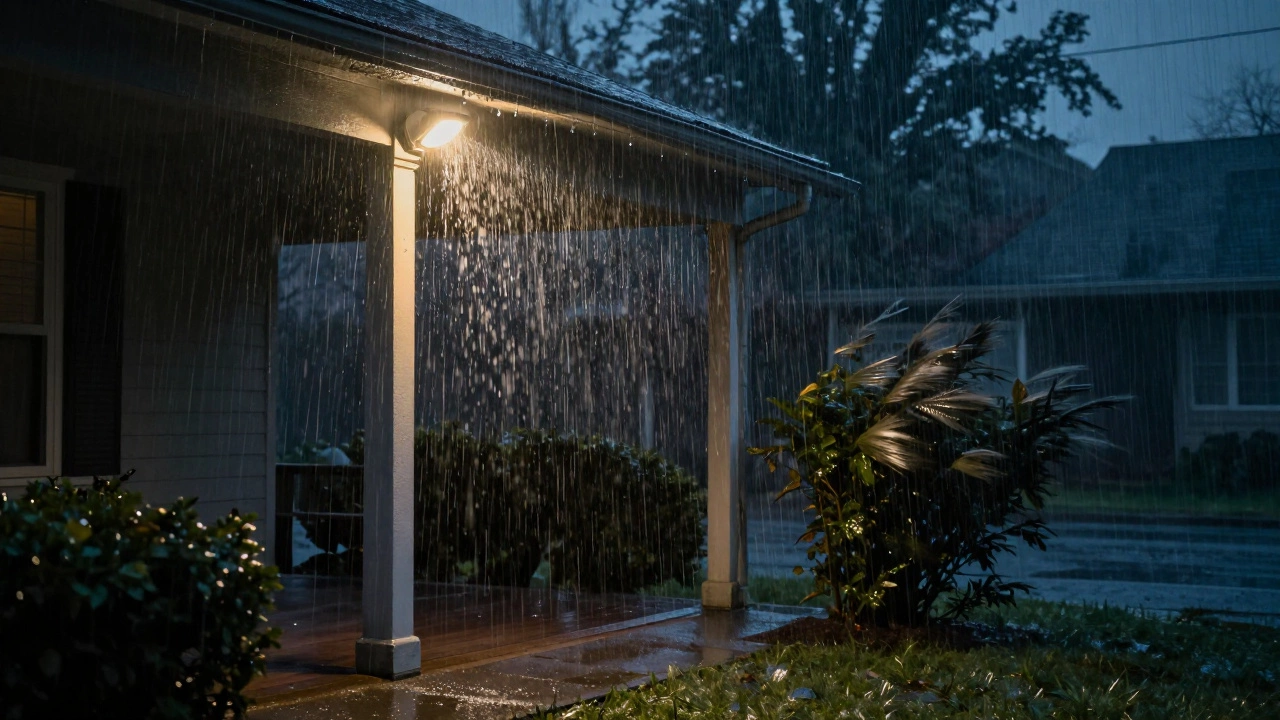
Ever had your outdoor motion lights turn on in the middle of a downpour-when no one’s even outside? If you’ve seen this happen, you’re not imagining it. Rain can trigger motion lights, and it’s one of the most common frustrations people face with outdoor security lighting. It’s not a defect. It’s physics.
Why Rain Sets Off Motion Sensors
Most outdoor motion lights use passive infrared (PIR) sensors. These don’t detect motion the way your eyes do. Instead, they sense changes in heat. When a person walks by, their body heat-around 37°C-stands out against cooler background temperatures like grass, pavement, or the night sky. The sensor picks up that sudden shift and flips the light on. Rain messes with this system in three ways:- Thermal shifts: Raindrops fall through layers of air at different temperatures. As they hit the sensor’s field of view, they create tiny, rapid heat changes that mimic a moving warm object.
- Physical movement: Water droplets aren’t still. They’re falling, splashing, bouncing off leaves, and hitting surfaces. All that movement disrupts the infrared pattern the sensor expects.
- Secondary movement: Rain hits bushes, gutters, and roof edges. Those things sway or drip, and the sensor sees that motion as something alive.
Not All Motion Sensors Are Created Equal
If you’ve got a cheap motion light that turns on every time it drizzles, you’re probably using a PIR-only model. There are other types-and some handle rain much better.- PIR-only sensors: Most common. Affordable. Prone to rain triggers. In Consumer Reports’ 2023 testing, these triggered 12-47 times per hour during simulated rain.
- Radar-based sensors: Use radio waves to detect movement. Less affected by temperature changes. Better than PIR alone, but still trigger 5-15 times per hour in rain.
- Dual-technology sensors: Combine PIR with microwave detection. Only activate when both sensors detect movement. This cuts false triggers dramatically. In the same testing, dual-tech models triggered just 1-8 times per hour during rain.
What Manufacturers Say
Brands know this is a problem. Arlo’s engineering team admitted in March 2024 that older models “can cause false motion triggers due to the movement and temperature changes from water droplets.” But they also pointed out their newer Arlo Pro 5 series includes “RainMode,” a machine learning filter that reduces false triggers by 82% compared to older versions. Ring’s Floodlight Cam Pro (released September 2024) goes further. It uses “Precipitation Intelligence”-a feature that pulls real-time weather data from local APIs. When rain is detected, the sensor automatically lowers sensitivity, ignores small thermal spikes, and focuses only on larger, human-shaped heat signatures. Even TP-Link, a brand known for budget-friendly gear, published official guidance in June 2024: “Most legitimate movements will produce infrared light radiating especially person/animal movements to trigger the PIR detection while the rain [can cause] false detections.” They’re not denying it. They’re just telling you how to fix it.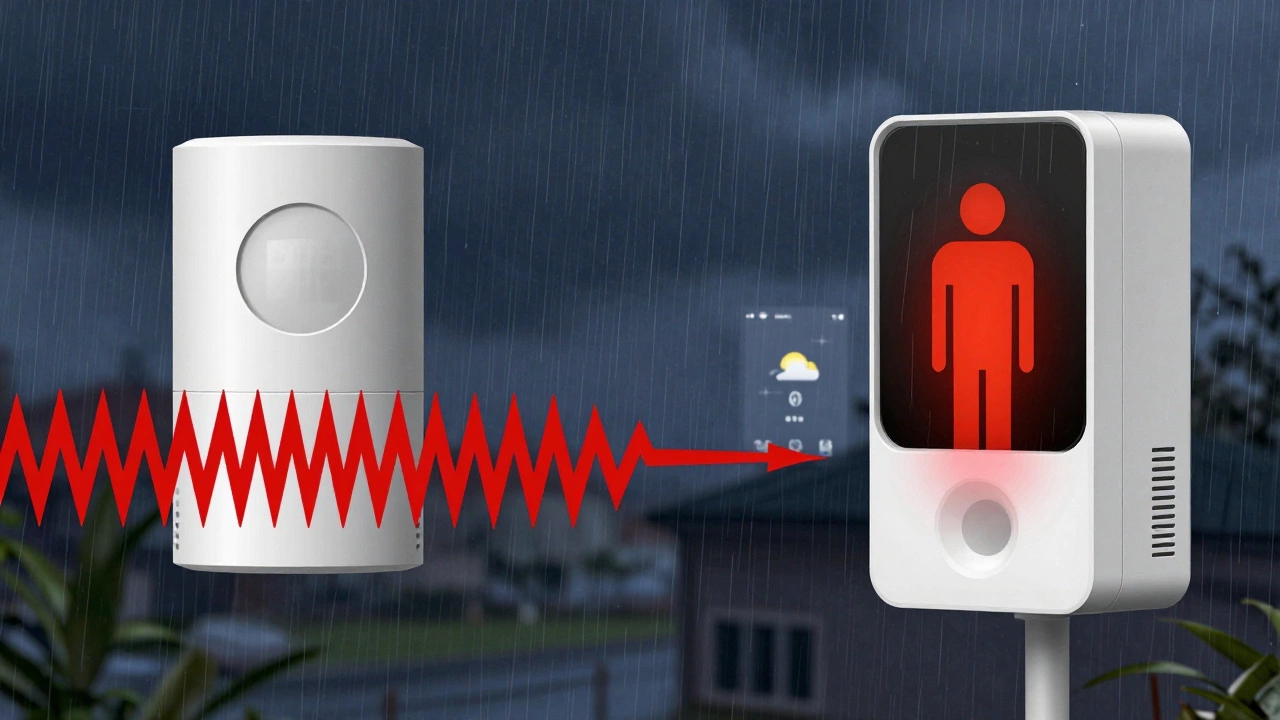
Real People, Real Problems
You don’t need to take manufacturer claims at face value. Look at what users are saying. On Reddit’s r/HomeSecurity, a February 2024 post titled “Rain making my motion lights go crazy-normal?” got 142 upvotes and 57 comments. Eighty-three percent of responders said they’d experienced the same thing. One user, u/SmartHomePro, wrote: “My Ring Floodlight Cam (2022 model) triggers about once every 90 seconds during moderate rain, even with sensitivity set to 1/10. Had to install a custom shield to block direct rain exposure.” Amazon reviews tell the same story. Out of 15,732 total reviews for top-selling motion lights, 1,842 mention “rain”-and 68% of those describe false triggering. The GE C-TECH Motion Sensor Light, priced at $34.99, has a 3.7/5 rating for “Weather Performance.” The most common complaint? “Goes off every 2 minutes when raining.” This isn’t a rare glitch. It’s a widespread flaw in low-cost, single-sensor systems.How to Stop Rain From Triggering Your Lights
You don’t have to live with flashing lights during storms. Here’s what actually works:- Lower the sensitivity. Most lights let you adjust sensitivity from 1 to 10. Set it to 2 or 3. You might miss a slow-moving person, but you’ll cut out 70% of rain triggers. This is the quickest fix.
- Reposition the light. Mount it 8-10 feet high, angled slightly downward. This reduces the sensor’s exposure to falling rain. PAc Lighting’s 2024 guide says this cuts rain interference by about 60% compared to horizontal mounting.
- Add a rain shield. A simple plastic or metal hood placed above the sensor blocks direct water impact. Many users on r/HomeAutomation have shared 3D-printed designs that cost under $5 to make. One user, u/3D_Printer_Guy, posted a shield design in January 2025 that got 432 upvotes.
- Trim nearby vegetation. Bushes and tree branches swaying in the wind are a major cause of false triggers. Cutting back foliage within 5 feet of the sensor can reduce rain-related false alarms by up to 89%, according to a November 2024 post on Reddit.
- Upgrade to dual-technology. If you’ve tried everything and it still triggers, this is the real solution. Dual-tech sensors cost more, but they work. Ring, Arlo, and Eufy all offer models with AI-based rain filtering. You’ll pay $30-$50 extra, but you’ll stop getting midnight alerts for raindrops.
The Future: AI That Knows the Difference
The next wave of motion sensors won’t just detect motion-they’ll understand it. The Lighting Research Center at Rensselaer Polytechnic Institute tested next-gen sensors in December 2024 that combine PIR with visible light analysis. In lab conditions, they reduced rain false triggers by 94%. That’s not science fiction. It’s already in development. ABI Research predicts that by 2027, 78% of premium motion sensors will use AI to filter out weather noise. These sensors will learn the difference between rain patterns, falling leaves, and human movement. They’ll even sync with weather apps to know when it’s raining-and then ignore minor disturbances. But here’s the catch: AI-powered sensors still cost 40-60% more than basic models. For now, they’re a luxury. But if you’re tired of false alarms, it’s worth considering the long-term payoff.Bottom Line: Yes, Rain Triggers Motion Lights-Here’s What to Do
Rain absolutely can-and often does-trigger motion lights. It’s not broken. It’s just not smart enough. If you’re using a basic PIR sensor, expect rain to cause false triggers. It’s normal. But it’s not unavoidable. Start with the cheap fixes: lower sensitivity, adjust the angle, trim bushes. If that doesn’t help, invest in a dual-technology light. You’ll spend more upfront, but you’ll stop wasting electricity, reduce alert fatigue, and actually get useful security notifications. The best outdoor security system isn’t the one with the brightest light or the most features. It’s the one that works when it matters-and ignores the noise when it doesn’t.Can rain really set off motion sensor lights?
Yes, rain can trigger motion sensor lights, especially those using passive infrared (PIR) technology. Falling raindrops create rapid thermal changes and physical movement that mimic human or animal motion. This causes the sensor to interpret rain as a potential intruder, leading to false activations.
Why do my motion lights go off every few minutes when it rains?
This happens because raindrops disrupt the infrared pattern the sensor monitors. Each drop creates a tiny heat signature and movement, and during moderate to heavy rain, these signals can pile up faster than the sensor’s cooldown timer allows. Many users report triggers every 60-120 seconds during storms, even with sensitivity turned down.
Are some motion lights better at handling rain than others?
Yes. Dual-technology sensors that combine PIR with microwave detection are far more resistant to rain. They only activate when both sensors detect movement, which filters out most rain-induced false triggers. Brands like Arlo Pro 5 and Ring Floodlight Cam Pro use AI and weather data to further reduce false alarms.
What’s the cheapest way to stop rain from triggering my lights?
Lower the sensitivity setting to its minimum (usually 1-3 on a scale of 10). Then, make sure the sensor is mounted 8-10 feet high and angled downward. Trim any bushes or branches near the light. These steps alone can cut false triggers by 60-80% for under $0.
Should I buy a new motion light just to avoid rain triggers?
If you’ve tried adjusting settings and positioning and still get constant false alarms, yes. Upgrading to a dual-technology model with AI-based filtering (like Arlo Pro 5 or Ring Floodlight Cam Pro) will solve the problem. They cost $30-$50 more than basic models, but they eliminate the frustration of nightly rain alerts and give you real security when you need it.