Hidden Camera Detection Checklist
Follow this systematic sweep to ensure your privacy. Check off each task as you complete it.
Sweep Complete!
You have systematically checked the room. If you found a device, remember: do not touch it, cover it, and contact authorities.
Walking into an Airbnb or a hotel room and wondering if someone is watching you isn't just paranoia-it's a legitimate privacy concern. With surveillance tech getting smaller every year, a camera can now be hidden inside a screw head or a tiny gap in a wall. The good news is that most of these devices leave a "digital footprint" or a physical tell that you can spot if you know where to look. Whether you have five minutes or an hour, you can effectively detect hidden camera setups using a few simple tricks and some affordable gear.
Start with a Manual Sweep
Before reaching for any gadgets, use your eyes. Most hidden cameras are placed at eye level or higher to get a wide angle of the room. Start by scanning the most obvious spots. Look for things that seem slightly "off"-maybe a smoke detector that looks brand new in an old building, or a decorative item that doesn't quite fit the room's style.
Focus on these high-probability areas:
- Power outlets and USB chargers: These provide a constant power source, making them perfect hiding spots.
- Smoke detectors and air vents: Their elevated position gives the camera a bird's-eye view.
- Clocks and picture frames: The small holes required for a lens are easy to hide in the frame or dial.
- Lamps and light fixtures: These often have hollow bases or shades where a lens can peek through.
Check for unusual screws or tiny pinholes in the furniture. If you see a small, circular hole in a place where there shouldn't be one, it's worth investigating further.
The Flashlight Reflection Test
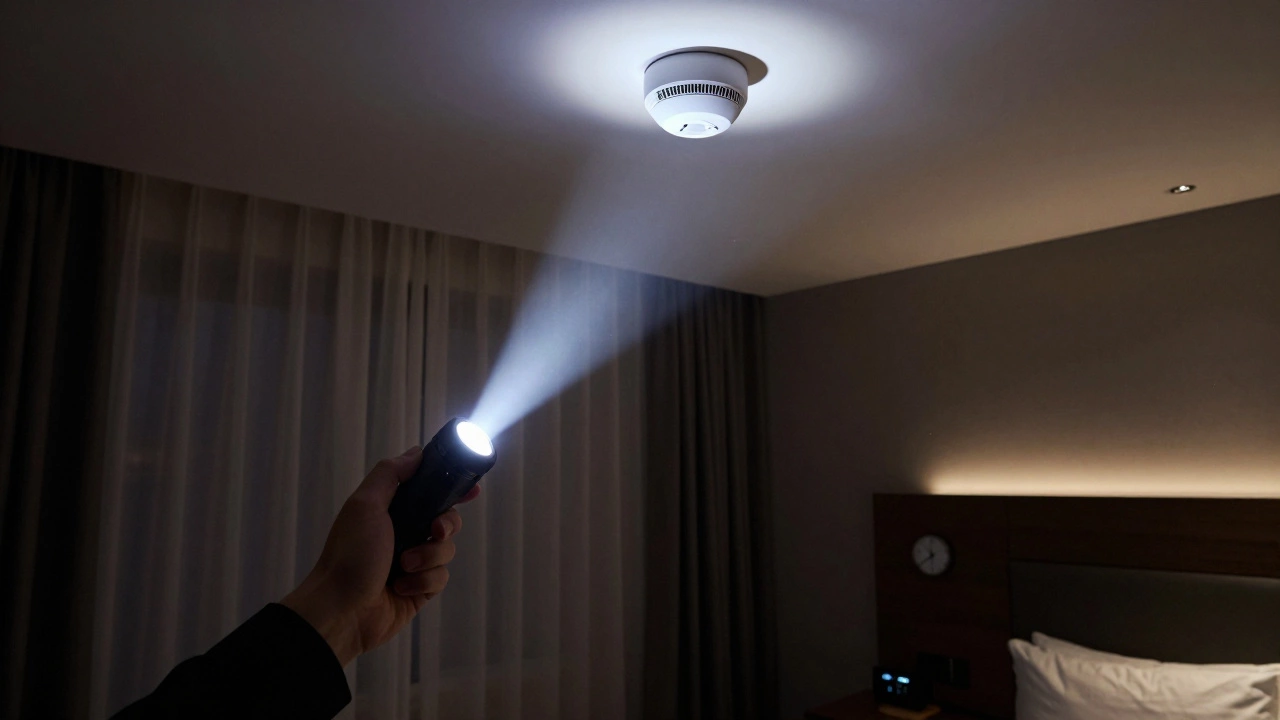
Camera lenses are made of glass, and glass reflects light. You can use a high-powered flashlight to find lenses that are invisible to the naked eye. To do this, close the curtains and turn off all the lights to make the room as dark as possible. Slowly shine your flashlight across the room, panning across shelves, corners, and electronics.
When the beam hits a camera lens, you'll often see a tiny, sharp glint of light. These reflections often appear as small blue or purple dots. It takes a bit of patience, but this is one of the most reliable ways to find a lens hidden inside a dark object, like a speaker or a fake plant.
Using Your Smartphone to Find Infrared Lights
Many hidden cameras use Infrared (IR) is invisible light used by cameras to see in the dark . While your eyes can't see IR light, the camera sensor in your smartphone can.
Here is how to do it:
- Turn off all the lights in the room.
- Open your phone's camera app (the front-facing "selfie" camera often works better because it usually lacks an IR filter).
- Slowly scan the room while looking at your screen.
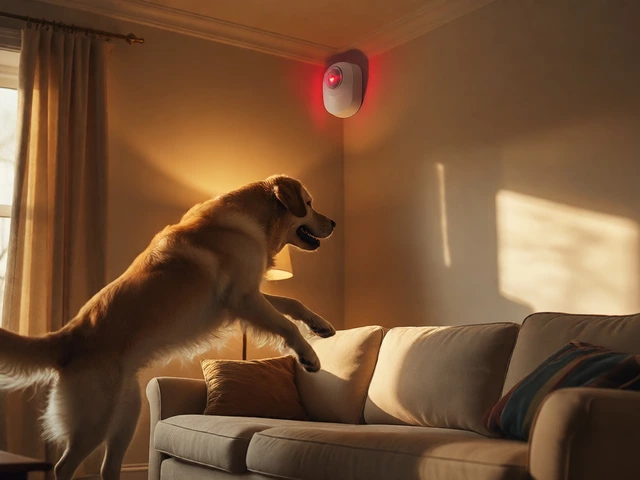
- Look for bright red or purple glowing dots.
If you see a steady glow coming from a smoke detector or a wall clock in total darkness, you've likely found an IR emitter used for night vision.
Advanced Detection with RF Detectors
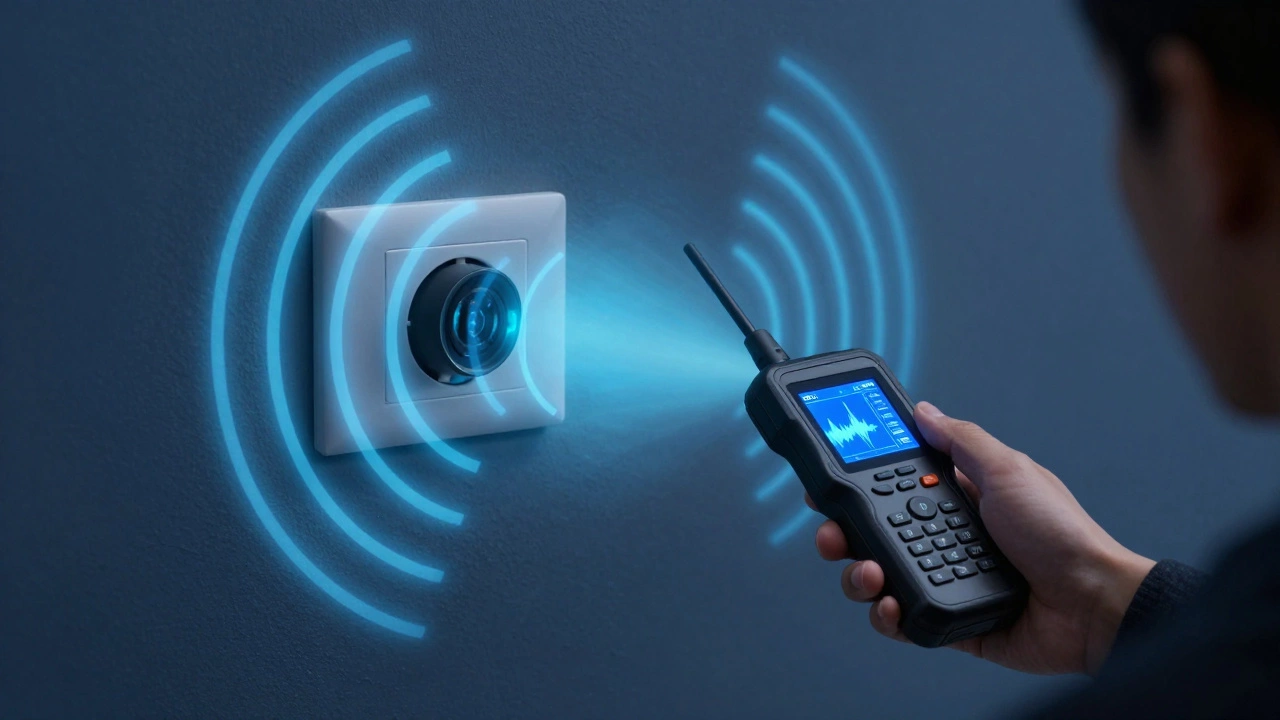
If a manual search doesn't give you peace of mind, you can use an RF Detector is a device that scans for radio frequencies emitted by wireless surveillance equipment . Wireless cameras must transmit data via Wi-Fi or cellular signals, and these devices pick up those signals.
| Detector Type | Price Range | Best For | Pros/Cons |
|---|---|---|---|
| Basic Entry-Level | $20 - $50 | Quick room sweeps | Cheap / Higher false positives |
| Mid-Range Multi-Frequency | $50 - $150 | Detailed searches | More accurate / Moderate cost |
| Professional Grade | $200+ | Security audits | High precision / Expensive |
To get the best results, turn off your own Wi-Fi router, smart speakers, and TV first. These devices create "noise" that can trigger false alarms. Move the detector slowly, a few inches away from the surface, and listen for the beep or vibration that signals a transmission is happening nearby.
Scanning the Network for IP Cameras
Most modern spy cameras are IP Cameras are digital cameras that send and receive data via a computer network . This means they show up as connected devices on the local Wi-Fi network.
If you have access to the router's admin panel, look for unfamiliar device names. Be on the lookout for technical labels like "IP_CAM" or "ESP32," which are common chips used in DIY spy cameras. If you're in a hotel and can't access the router, you can use a network scanning app like Fing is a network scanning tool used to identify all devices connected to a specific Wi-Fi network . It provides a list of every connected device along with its MAC address and manufacturer, making it easier to spot a camera that shouldn't be there.
The Two-Way Mirror Trick
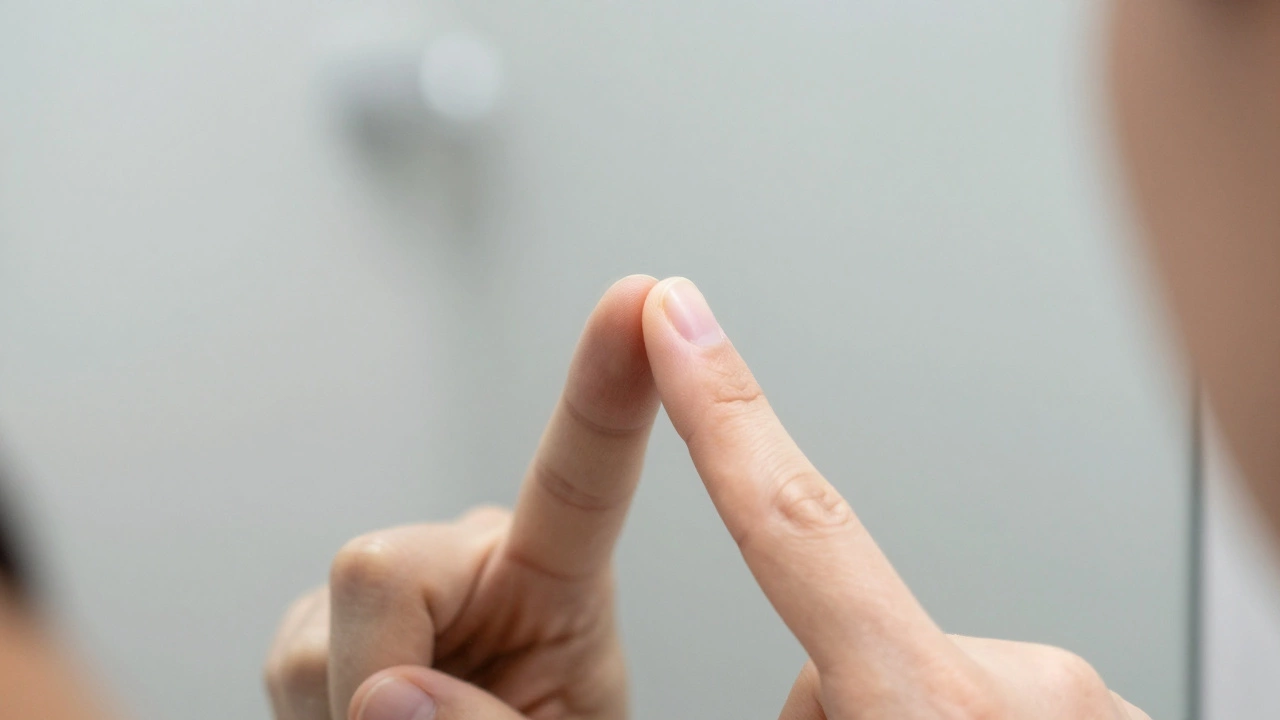
One of the most invasive places for a camera is behind a mirror in a bathroom or bedroom. To tell if a mirror is actually a two-way mirror, use the "fingertip test." Place your finger against the glass. In a standard mirror, there is a visible gap between your finger and the reflection. If your finger and the reflection touch tip-to-tip with no gap, it may be a two-way mirror, and there could be a camera or a person on the other side.
What to do if you find a camera
Finding a hidden camera is jarring. If you discover one, do not touch it or try to dismantle it, as you might destroy evidence. Instead, cover the lens with a piece of opaque tape or a towel, or simply unplug it if it's plugged into a wall outlet. Take photos of the device and its location, and contact the local authorities or the property management immediately.
Can I find a hidden camera with just my phone?
Yes, you can. The most effective way is by using the camera app to scan for infrared (IR) lights in a dark room. You can also use network scanning apps like Fing to see if any suspicious IP cameras are connected to the local Wi-Fi.
Do RF detectors work for all cameras?
RF detectors only work for wireless cameras that transmit data. They will not detect "wired" cameras that record to an internal SD card or send data through a physical cable.
What is the fastest way to check a hotel room?
The fastest method is a combination of a visual sweep of common spots (smoke detectors, clocks) and the flashlight test to check for lens reflections.
How can I tell if a mirror is a two-way mirror?
Use the fingertip test: if there is no gap between your finger and its reflection, it is likely a two-way mirror. A normal mirror always has a small gap.
Are there any free apps to detect cameras?
While there are no apps that can "see" through walls, network scanners like Fing are free for basic use and can help identify wireless cameras connected to the Wi-Fi.