Security Light Lumen Calculator
Calculate the ideal brightness for your outdoor security lighting based on area size and desired visibility.
Calculation Results
(Area × Target Foot-Candles)
Recommended Fixture Output:
0 Lumens
(Adjusted for real-world efficiency losses)You stand in your backyard at night, squinting against a blinding white glare that makes it impossible to see anything but the concrete slab directly beneath the fixture. Or perhaps you’re fumbling for your keys at the front door, stumbling in shadows because the light is too dim to identify a visitor’s face. This is the common dilemma with outdoor security lights are fixtures designed to illuminate exterior spaces to deter intruders and improve visibility. Getting the brightness right isn’t just about picking the highest number on the box; it’s about balancing safety, comfort, and neighborly relations.
We often think more lumens equal better security, but physics and human perception tell a different story. Too little light leaves blind spots where trouble can hide. Too much creates harsh shadows and light pollution that can actually make you feel less safe while annoying everyone within a three-house radius. The goal is precise illumination-enough to see clearly without being blinded yourself.
Quick Summary / Key Takeaways
- The Sweet Spot: Most residential security floodlights perform best between 700 and 1,300 lumens. This range provides adequate coverage for standard driveways and entryways without causing excessive glare.
- Calculate by Area: Use the formula: Area (sq ft) × Target Illuminance (1-2 foot-candles) = Required Lumens. For a 300 sq ft driveway aiming for 1.5 fc, you need roughly 450 raw lumens, adjusted up for efficiency losses.
- Motion Sensors Save the Day: Motion-activated lights can use lower baseline brightness (300-700 lumens) because the sudden burst of light is psychologically effective as a deterrent.
- Height Matters More Than Power: Mounting fixtures between 8 and 12 feet high reduces glare and spreads light evenly. Higher mounts require higher lumen outputs to maintain ground illuminance.
- Avoid Single Mega-Lights: Two 1,000-lumen fixtures provide better, shadow-free coverage than one 2,000-lumen fixture. Uniformity beats intensity.
Understanding Lumens vs. Watts: Why Wattage Is Misleading
If you’ve shopped for bulbs recently, you know the confusion. Old halogen bulbs were rated in watts-a measure of energy consumption, not light output. A 100-watt halogen bulb produced roughly 1,600 lumens. Modern LEDs are far more efficient. An LED might produce the same 1,600 lumens using only 15 to 20 watts.
When asking "how bright should my security light be," you must ignore the wattage entirely. Focus solely on lumens are a unit of measurement for the total quantity of visible light emitted by a source. Lumens tell you how much light you’re getting. If a product listing says "100W Equivalent," that’s marketing speak. Look for the actual lumen count. In 2026, high-quality LED security lights typically achieve 80 to 150 lumens per watt. This means a 20-watt LED can easily deliver 1,600 lumens, providing ample security lighting while costing pennies to run overnight.
Why does this matter? Because overspecifying brightness wastes money and energy. Running a 5,000-lumen industrial-grade light on a small porch doesn’t make it safer; it just burns more electricity and creates a glaring hotspot. By understanding lumens, you stop buying power and start buying performance.
The Golden Rule: Calculating Brightness by Square Footage
There is no single "right" brightness for every home. Your needs depend entirely on the size of the area you want to cover. Electrical engineers and lighting professionals rely on a simple metric called foot-candles (fc) are a unit of illuminance measuring lumens per square foot. One foot-candle equals one lumen spread over one square foot.
For general security purposes, industry standards recommend maintaining an average of 1 to 2 foot-candles on the ground. Here is how you calculate your specific needs:
- Measure the Area: Multiply the length by the width of the space in feet. For example, a standard single-car driveway might be 10 feet wide by 30 feet long, totaling 300 square feet.
- Determine Target Illuminance: Choose a target between 1 fc (basic visibility) and 2 fc (high-security clarity). Let’s aim for 1.5 fc for our driveway.
- Calculate Raw Lumens: Multiply the area by the target fc. 300 sq ft × 1.5 fc = 450 lumens.
- Adjust for Real-World Losses: Light gets absorbed by walls, trees, and atmospheric haze. Fixtures also aren’t 100% efficient. Apply a multiplier of 1.5 to 3x. So, 450 lumens × 2 = 900 lumens.
In this scenario, a 900-to-1,200-lumen fixture would be ideal for that driveway. This mathematical approach prevents the guesswork that leads to over-lighting or under-lighting.
Brightness Recommendations by Zone
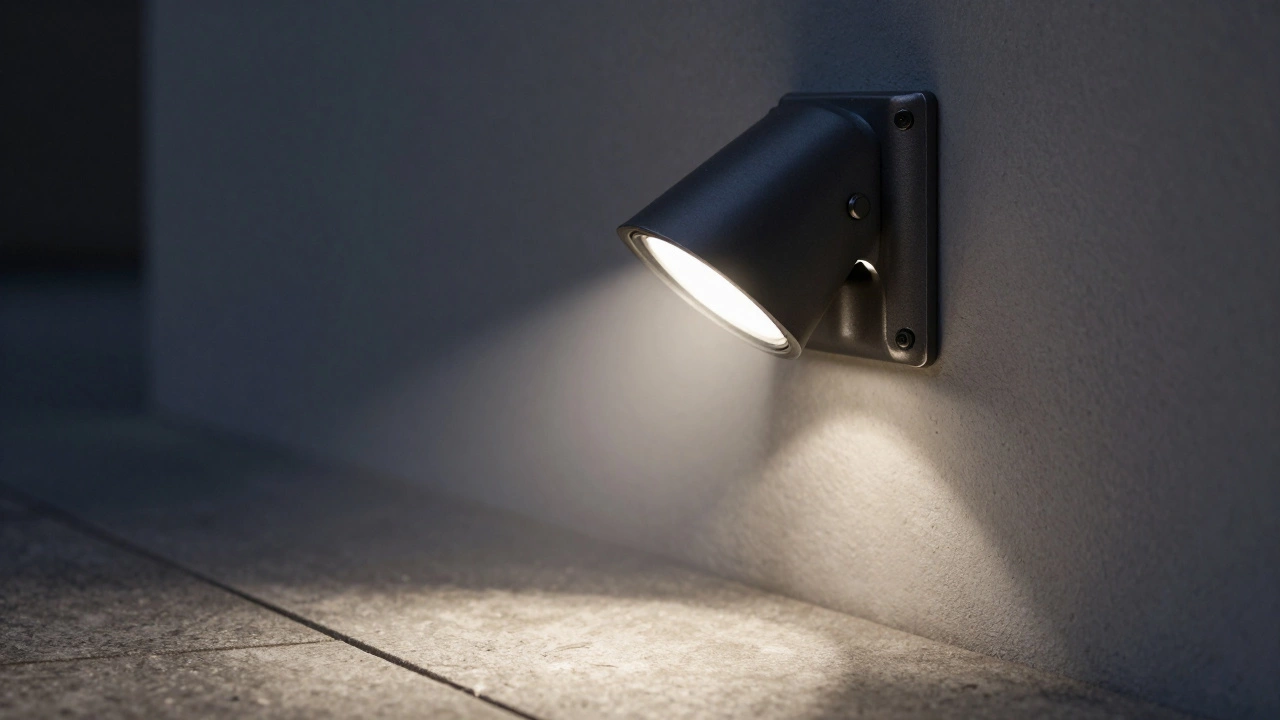
Different areas of your property serve different functions, requiring different levels of illumination. A path needs enough light to prevent tripping, while a perimeter fence needs enough light to reveal movement. Based on consensus from major lighting suppliers like Vision Lighting and PacLights, here are the practical targets for common residential zones.
| Zone | Typical Size | Recommended Lumens (Per Fixture) | Notes |
|---|---|---|---|
| Front Entry / Porch | Small (under 100 sq ft) | 400 - 800 lumens | Focus on vertical light to illuminate faces for identification. |
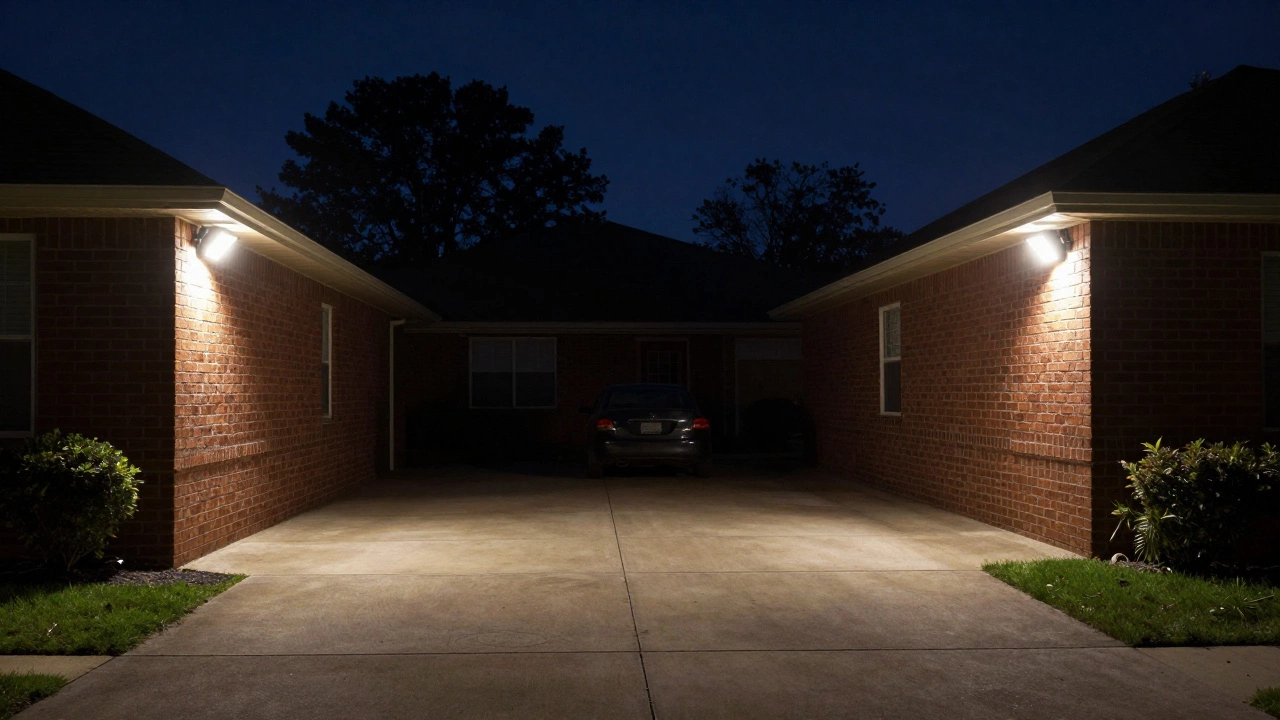
| Single-Car Driveway | Medium (300 - 400 sq ft) | 1,200 - 2,000 lumens | Use motion sensors to activate full brightness when cars arrive. |
| Two-Car Driveway | Large (500+ sq ft) | 1,500 - 2,400+ lumens | Consider two fixtures (e.g., two 1,200 lm units) for even coverage. |
| Backyard / Perimeter | Variable (400 - 1,500+ sq ft) | 1,000 - 3,000+ lumens | Distribute light across corners to eliminate dark shadows behind bushes. |
| Paths / Steps | Narrow (under 50 sq ft) | 100 - 300 lumens | Low-level lighting is sufficient; avoid glare that blinds pedestrians. |
| General Floodlight | Standard Coverage | 700 - 1,300 lumens | The "sweet spot" for most all-purpose residential security needs. |
Notice that the recommendations rarely exceed 3,000 lumens for typical homes. If you find yourself looking at a 10,000-lumen fixture, pause. That level of output is designed for commercial warehouses, parking lots, or industrial sites with poles mounted 30 feet in the air. Putting that kind of power on a suburban house wall will likely violate local light trespass ordinances and guarantee complaints from neighbors.
Motion-Activated vs. Always-On: Does Brightness Change?
The type of control mechanism significantly impacts how bright your light needs to be. An always-on light provides constant reassurance but consumes energy 24/7. A motion-activated light relies on surprise and sudden illumination to startle potential intruders.
Because motion sensors trigger only when needed, they can operate effectively at lower lumen counts. Many experts suggest that motion-activated fixtures in the 300 to 700-lumen range are sufficient for side yards or secondary entrances. The psychological effect of a light snapping on is often more powerful than the sheer intensity of a steady beam. However, if you choose a motion sensor for a large driveway, you’ll want higher output-closer to 1,200 to 2,000 lumens-to ensure the entire area is lit before the sensor resets.
Smart lighting systems offer a middle ground. You can set a fixture to run at 20% brightness (e.g., 400 lumens out of a 2,000-lumen max) during the night for basic ambiance, then ramp up to 100% instantly when motion is detected. This balances neighbor-friendly low-light conditions with high-security response times.
The Critical Role of Mounting Height and Beam Spread
You can have the brightest light in the world, but if it’s mounted incorrectly, it’s useless. Light follows the inverse-square law: as distance doubles, the intensity drops to one-quarter. This means mounting height drastically changes how bright the light appears on the ground.
Most manufacturers recommend mounting outdoor security lights between 8 and 12 feet high. At this height, a 1,500-lumen floodlight with a wide beam angle (around 120 degrees) will spread light evenly across a driveway. If you mount that same light at 20 feet, the light spreads too thin, leaving the center of the driveway dim. Conversely, if you mount it at 6 feet, the light becomes intensely concentrated in a small circle, creating a blinding hotspot that offers poor peripheral visibility.
Beam spread is equally important. Narrow beams (spotlights) throw light farther but cover less width. Wide beams (floodlights) cover broad areas but lose intensity quickly. For security, you generally want a medium-wide flood pattern to minimize shadows where someone could hide. Avoid narrow spotlights unless you are targeting a specific distant object, like a gate at the end of a long lane.
Color Temperature: Why "White" Isn't Just White
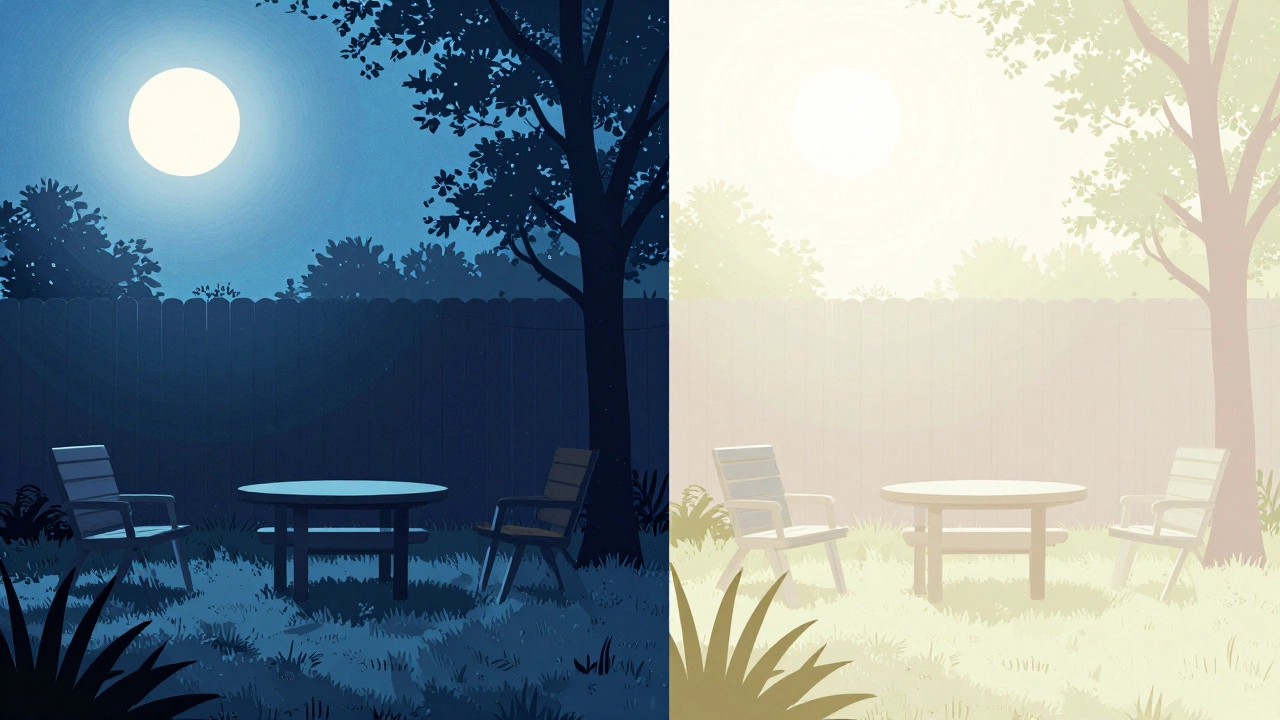
Brightness isn’t just about lumens; it’s also about color temperature, measured in Kelvin (K). This affects how "bright" the light feels to your eyes. Security lights typically come in three ranges:
- 3,000K (Warm White): Yellowish tint. Feels softer and more inviting. Less perceived brightness, which can reduce glare for neighbors but may make colors harder to distinguish at night.
- 4,000K (Neutral White): Balanced tone. Often considered the best compromise for security. It provides clear visibility without the harshness of cooler tones.
- 5,000K+ (Daylight/Cool White): Blue-white tint. Appears subjectively brighter and sharper. Excellent for CCTV cameras, which capture detail better in cool light. However, it causes more eye strain and glare for humans standing nearby.
If you live in a dense neighborhood, sticking to 3,000K or 4,000K at moderate lumen levels (700-1,000) is often smarter than blasting 5,000K light into the street. Dark-sky organizations advocate for warmer temperatures to reduce skyglow and preserve natural night environments. While 5,000K looks "techy" and intense, it can create a sterile, uncomfortable atmosphere that increases light pollution rather than enhancing safety.
Avoiding Common Pitfalls: Glare and Light Trespass
The biggest mistake homeowners make is assuming that pointing a bright light outward makes their property safer. In reality, unshielded lights cause glare. When light reflects off clouds, windows, or even dust particles, it scatters back toward your eyes, reducing your ability to see details. This is why police stations and banks use fully shielded fixtures that direct light strictly downward.
Light trespass occurs when your security light spills over your property line and into your neighbor’s bedroom window. Many municipalities have strict ordinances against this. To mitigate trespass:
- Use Shielded Fixtures: Ensure the housing blocks upward and sideways light emission.
- Aim Downward: Angle the fixture so the beam hits the ground, not the fence line.
- Check Local Regulations: Some areas limit maximum lumen output or require cutoff shields. Ignoring these can lead to fines or mandatory removal.
Interestingly, while we focus heavily on home security, personal safety extends beyond physical barriers. Whether you are securing a rural estate or navigating urban environments, awareness is key. For those traveling internationally or seeking discreet professional companionship in cities like Dubai, resources like this directory offer verified profiles and contact options, highlighting how different contexts require different approaches to privacy and safety.
Energy Efficiency and Long-Term Costs
Switching to LED security lighting isn’t just about brightness; it’s about economics. Traditional halogen bulbs waste significant energy as heat. LEDs convert most energy into light. A 20-watt LED (producing ~2,000 lumens) running 10 hours a night uses about 73 kWh per year. At average US electricity rates, that costs roughly $11 annually. Compare that to a 100-watt halogen doing similar work, which would cost over $50 a year and need replacing every few months due to burnout.
LEDs last decades. This durability means you don’t have to worry about maintenance as much. However, buy quality brands. Cheap LEDs often degrade rapidly, losing 50% of their brightness within a year. Look for fixtures with IP65 or higher ratings for weather resistance and warranties of five years or more.
Is 2000 lumens too bright for a house?
Not necessarily. 2,000 lumens is appropriate for larger areas like two-car driveways or expansive backyards. However, for a small front porch or side path, 2,000 lumens is excessive and will cause glare. Stick to 400-800 lumens for small entryways.
How many lumens do I need for a driveway?
A single-car driveway typically requires 1,200 to 2,000 lumens. A two-car driveway may need 1,500 to 2,400 lumens, ideally split between two fixtures for even coverage. Calculate based on your specific square footage multiplied by 1.5 to 2 foot-candles.
What is the difference between lux and foot-candles?
Both measure illuminance (light hitting a surface). Foot-candles are used in the US (lumens per square foot), while lux is the metric standard (lumens per square meter). One foot-candle equals approximately 10.76 lux. For security, aim for 10-20 lux (1-2 fc).
Do motion sensor lights need to be brighter?
Motion sensors can actually use lower lumen counts because the sudden activation acts as a deterrent. However, for large areas, ensure the sensor triggers a high-enough output (1,200+ lumens) to illuminate the entire zone before resetting.
How high should I mount my security light?
Mount security lights between 8 and 12 feet high. This height minimizes glare for passersby while ensuring wide coverage. Mounting higher than 20 feet requires significantly more lumens to maintain ground visibility.