Flashlight Beam Distance Calculator
Enter your flashlight's specifications to estimate how far it shines. Remember: Lumens measure total light output, while Candela measures focus. High Candela equals longer throw.
Estimated Performance
-- m
Point where beam drops to barely visible shadow.-- m
Distance to clearly identify faces/objects.Visual Representation
You might think that if you buy a 5000-lumen flashlight or security light, it will automatically shine twice as far as a 2500-lumen model. But here is the catch: lumens measure total brightness, not how far that light travels. Two lights with the exact same 5000-lumen rating can have completely different ranges-one might only reach 180 meters while another hits 650 meters. The secret isn't in the lumens; it's in the candela and the beam shape.
The Short Answer: It Depends on Candela
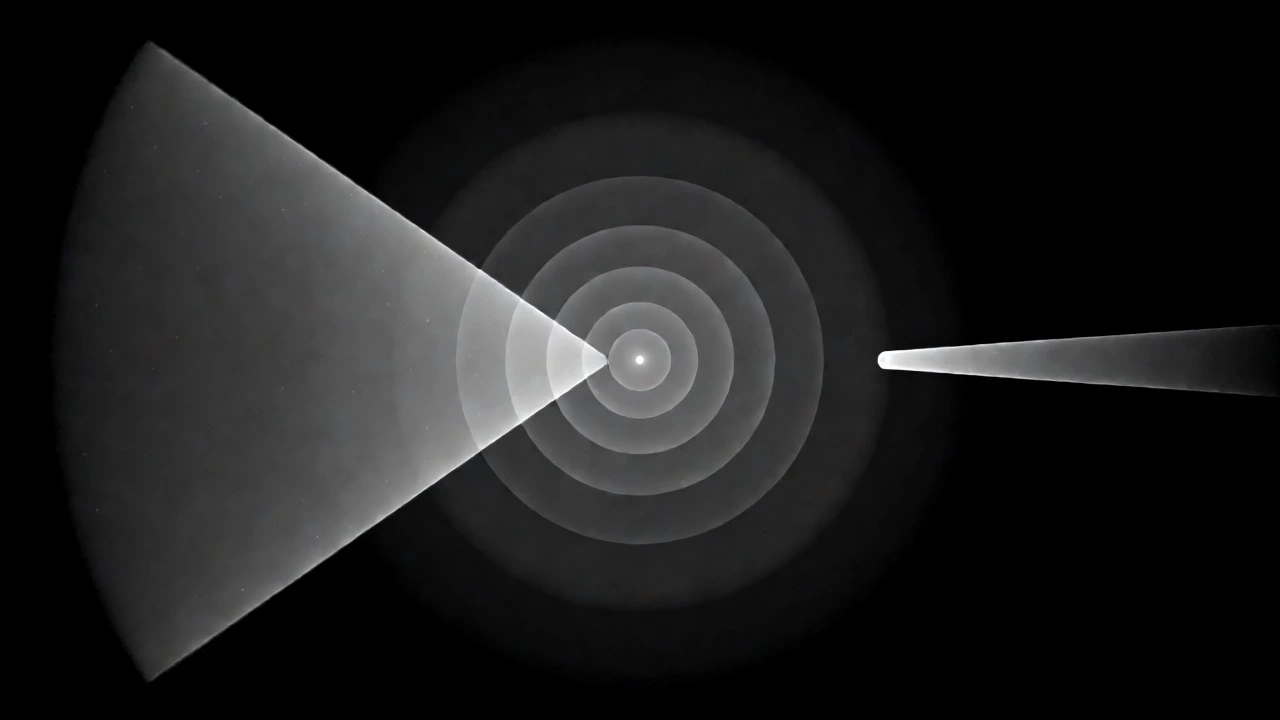
If you need a quick number, a typical consumer-grade 5000-lumen flashlight shines effectively between 200 and 350 meters. However, tactical or "thrower" models designed for long distance can push this out to 400-650 meters. In rare, specialized cases with extreme optics, you might see distances over 1,000 meters, but those are outliers. Why the huge gap? Because lumens tell you how much light comes out of the bulb, while candela tells you how tightly that light is focused into a beam. A wide floodlight spreads its 5000 lumens everywhere, making things bright up close but dim at a distance. A spotlight concentrates those same lumens into a tight circle, throwing them much farther.
Lumens vs. Candela: The Core Difference
To understand why two identical-looking bulbs perform differently, you have to look at the physics. Lumens (lm) measure the total amount of visible light emitted by a source. Think of lumens like the total water coming out of a hose. If you put your thumb over the end, you don't change the amount of water (lumens), but you change how far it shoots. That shooting power is measured in candela (cd), which measures luminous intensity in a specific direction.
The relationship is governed by the inverse-square law. As light travels, it spreads out. The formula for illuminance (lux) on a target surface is $E = I / D^2$, where $I$ is candela and $D$ is distance in meters. This means if you double the distance, the light intensity drops to one-quarter. A high-candela beam maintains usable brightness much longer because it starts with higher intensity per square meter.
Real-World Examples: What Do Specs Actually Mean?
Let’s look at actual products sold today to see how 5000 lumens translates to real-world distance. Manufacturers often list "beam distance," but this is usually the point where the beam drops to 0.25 lux-barely enough to see a shadow, not to identify a person.
| Model | Beam Type | Candela (cd) | Rated Throw | Practical Range |
|---|---|---|---|---|
| Infinity X1 | Flood/Mixed | 8,100 cd | 180 m | ~100-150 m |
| NEBO LEO 5000 FLEX | General Use | N/A (Low Intensity) | 190 m | ~120-180 m |
| Nitecore P17iX | Tactical | Medium | 330 m | ~250-300 m |
| Fenix TK35UE V2.0 | Balanced | High | 400 m | ~300-350 m |
| Acebeam L35 | Thrower | 57,600 cd | 480 m | ~400-450 m |
| Acebeam L35 v2 | Extreme Thrower | Very High | 650 m | ~500-550 m |
Notice the Infinity X1 and the Acebeam L35 both produce 5000 lumens. Yet, the Acebeam throws more than twice as far. Why? The Acebeam uses a deep reflector and a small LED emitter to concentrate the light into a hot spot (high candela). The Infinity X1 likely uses a wider reflector or lens to spread the light for area coverage (low candela). For outdoor security, do you want to see the whole driveway (flood) or spot an intruder at the gate (throw)?
How to Calculate Your Own Beam Distance
If you’re shopping online and only see lumens, you might be flying blind. Here is a simple rule of thumb used by enthusiasts to estimate throw from candela:
- Formula: Throw Distance (meters) ≈ $2 \times \sqrt{\text{Candela}}$
- Example: If a light has 10,000 candela, the math is $2 \times \sqrt{10,000} = 2 \times 100 = 200$ meters.
- Example: If a light has 40,000 candela, the math is $2 \times \sqrt{40,000} \approx 2 \times 200 = 400$ meters.
This formula assumes the industry standard definition of "beam distance," which is the point where the beam center drops to 0.25 lux. At 0.25 lux, you can barely distinguish shapes. For practical use-like identifying a face or reading a sign-you need about 1 to 5 lux. This means your usable range is often 30-50% shorter than the advertised maximum throw.
Why Independent Tests Differ from Manufacturer Claims
Don’t trust the box alone. Independent reviewers often find discrepancies. For instance, the Wurkkos TS23 claims a 482-meter throw at 5000 lumens. However, independent testing by 1Lumen measured a peak intensity of 28,400 candela, which calculates to roughly 337 meters. That’s a significant difference.
Manufacturers sometimes test under ideal conditions with fresh batteries and perfect cooling. In the real world, heat causes "thermal throttling." A 5000-lumen light running at full turbo mode will get hot quickly. To prevent damage, the driver reduces power after a few minutes. So, that 480-meter beam might drop to 300 meters after five minutes of continuous use. Always check reviews for "sustained output" rather than just "peak output" if you need reliable long-distance lighting for security patrols.
Choosing the Right Light for Outdoor Security
So, should you buy a 5000-lumen light for your backyard? It depends on what you are trying to solve.
Scenario 1: General Area Illumination
If you want to light up a patio or walkway so guests don’t trip, a high-lumen floodlight is great. You don’t care about seeing 500 meters away; you care about uniform brightness within 10-20 meters. In this case, a 5000-lumen flood with lower candela is actually better because it reduces harsh shadows.
Scenario 2: Perimeter Detection
If you need to spot movement at the edge of your property (e.g., 100-200 meters out), you need a balanced beam. Look for lights with 15,000-25,000 candela. These offer a mix of spill (side light) and throw (center light).
Scenario 3: Long-Range Spotting
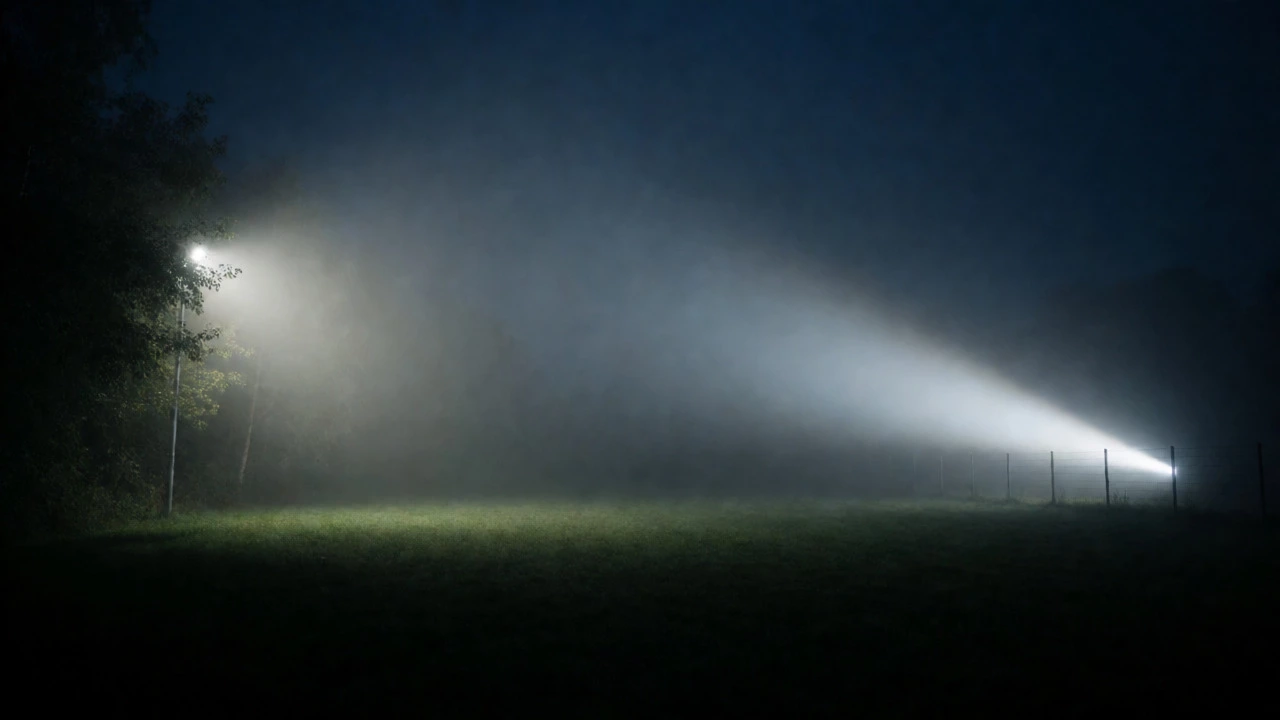
For hunting, search-and-rescue, or checking distant gates, you need a "thrower." Look for candela ratings above 40,000. These lights will have a narrow beam, almost like a laser pointer made of light. They are less useful for walking around because they create a tunnel-vision effect, but they excel at punching through darkness.
Common Pitfalls to Avoid
When buying high-output lights, watch out for these traps:
- Ignoring Battery Life: 5000 lumens drains batteries fast. Many lights only sustain this output for 1-3 minutes before dropping to a lower level. Check for "step-down" times.
- Confusing Lux with Lumens: Some cheap brands advertise "Lux" as a primary metric without specifying the distance. Ask: "At what distance is this lux measurement taken?"
- Overlooking Color Temperature: Cool white (5000K+) looks brighter to the human eye but renders colors poorly. Warm white (3000K) penetrates fog and rain better but may feel dimmer. For security, neutral white (4000K-5000K) is often the best compromise.
Final Thoughts
There is no single answer to "how far does 5000 lumens shine." It is a question of geometry, not just power. A wide flood spreads its energy thin, reaching only 150-200 meters effectively. A tight spotlight focuses that same energy, reaching 400-600 meters. When you shop, ignore the lumen count for a moment and look for the candela rating. That number tells you the truth about range. If you can’t find candela data, assume the light is optimized for area coverage unless it explicitly says "long throw" or shows a narrow beam pattern in photos.
Is 5000 lumens too bright for home security?
Not necessarily, but it can be blinding if pointed directly at neighbors or cameras. For fixed security lights, 2000-3000 lumens is often sufficient for driveways. For handheld flashlights, 5000 lumens is excellent for spotting threats but should be used with a diffuser or aimed carefully to avoid ruining night vision.
Why does my 5000 lumen light get hot?
Producing 5000 lumens requires significant electrical power, typically 30-50 watts. Most of this energy turns into heat. Aluminum bodies act as heat sinks to draw this heat away from the LED. If the light feels uncomfortably hot, it is working correctly to protect itself from burning out.
Can I compare beam distance across different brands?
Only if they use the same standard. Most reputable brands follow the ANSI FL1 standard, which defines beam distance as the point where intensity hits 0.25 lux. Be wary of brands that don't cite ANSI standards, as their measurements may be arbitrary or optimistic.
Does battery type affect beam distance?
Yes. High-drain lithium-ion batteries (like 18650 or 21700 cells) maintain voltage better under load than alkaline batteries. As voltage drops, the light dims and the beam shortens. Always use high-quality rechargeable lithium batteries for consistent performance.
What is the difference between flood and throw?
Flood refers to the width of the beam, illuminating a large area nearby. Throw refers to the length of the beam, illuminating distant objects. A 5000-lumen flood light might light up a 20-meter circle brightly. A 5000-lumen throw light might illuminate a coin-sized spot 400 meters away. Most quality lights offer a mix of both.